Podcasts des conférences du GIS
Cycle of talks : Cultural Transfers in European, Colonial and Global Contexts (1650-1850): the Circulation of Models of Sociability.
-
Susanne SCHMID (Lecturer in English Literature and Culture, Berlin Free University) : "'We dined upon the very edge of the crater': British Women Travellers in Italy, Sociability and Cultural Transfer".
Maison de la Recherche, Paris, 13 April 2019:
Link to podcast: https://ubotube.univ-brest.fr/videostream/video/conf-gis-schmid/
-
Mrinalini SINHA (Professor in History, University of Michigan, USA) : "Undoing Imperial Sociability: The Indianization of an Imperial Institution and the Limits of Cultural Transfers".
Maison de la Recherche, Paris7 December 2018:
Link to podcast: https://ubotube.univ-brest.fr/videostream/video/conf/
-
Bertrand VAN RUYMBEKE (Professor in American civilization, Université Paris 8 / IUF) : "L'Amérique au concours. Les Académies en France et le Nouveau Monde au XVIIIe siècle".
https://ubotube.univ-brest.fr/videostream/video/b/
Musée Cognacq-Jay, 5 April 2019: -
Stéphane VAN DAMME (Professor in Modern History, European University Institute, Florence, Italie) : "Globaliser la culture antiquaire française : Paul Lucas, marchand, espion et collectionneur au seuil des Lumières".
Musée Cognacq-Jay, 17 May 2019:
Link to podcast: https://ubotube.univ-brest.fr/videostream/video/b/
Cycle of talks : Sociabilités et libertinage au siècle des Lumières in parallel with the exhibition "L'Empire des sens: de Boucher à Greuze" - Musée Cognacq-Jay.
-
Jean-Christophe ABRAMOVICI (Sorbonne Université) : "Le libertinage peut-il faire société ? Diderot au Salon", online, 3 June 2021
Link to podcast: https://ubotube.univ-brest.fr/videostream/video/sociabilite-libertinage-3-06-21/
-
Michel DELON (Sorbonne Université) : "Jardins libertins au XVIIIème siècle", online, 17 June 2021
Link to podcast: https://www.youtube.com/watch?v=9QUZcMYRRoQ
-
Ariane FENNETAUX (Associate Professor in British History, Université de Paris): "Lorgnettes, boîtes à priser et étuis : sociabilité de poche au XVIIIe siècle".
Musée Cognacq-Jay, 11 octobre 2019:
Link to podcast: https://ubotube.univ-brest.fr/videostream/video/a/
-
Patrick MICHEL (Professor in Art history, Université de Lille) : "Le cabinet du collectionneur au XVIIIe siècle : espace de l’échange, de la circulation des idées, des savoirs et des objets".
Musée Cognacq-Jay, 22 November 2019:
Link to podcast: https://ubotube.univ-brest.fr/videostream/video/p/
-
Brian COWAN (Professor and Canada Research Chair in Early Modern British History, McGill University): "The Politics of Celebrity in post-revolutionary Britain".
Musée Cognacq-Jay, 13 December 2019:
Link to podcast: https://ubotube.univ-brest.fr/videostream/video/conference-du-gis/
-
Brian COWAN (McGill University): "Histories of Fame and Celebrity in Early Modern Perspective" // Antoine LILTI (EHESS): "De la sociabilité à la célébrité : l’espace public des Lumières", online, 11 December 2020
Link to podcast: https://ubotube.univ-brest.fr/videostream/video/sociabilite/
-
Nina Kushner (Clark University): "Unfaithful Wives, Angry Husbands, and their “Immediate Communities”: The Meaning of Adultery in Eighteenth-Century France." online, 9 November 2021
Link to podcast: https://www.youtube.com/watch?v=EYZr_LD6Yes
-
Frédéric Ogée (Université de Paris): "Plaisirs des sens, plaisirs de l’imagination dans l’art et la littérature anglaise du 18ème siècle". Musée Cognacq-Jay, Paris, 26 November 2021
Link to podcast: https://www.youtube.com/watch?v=_e2Tgej05QY&feature=youtu.be
Past events
- Colloques
-
International conference: 'Sociable Spaces in the Long Eighteenth Century (1650-1850) from Present-day Perspectives'.
Brest, 23 & 24 May 2019
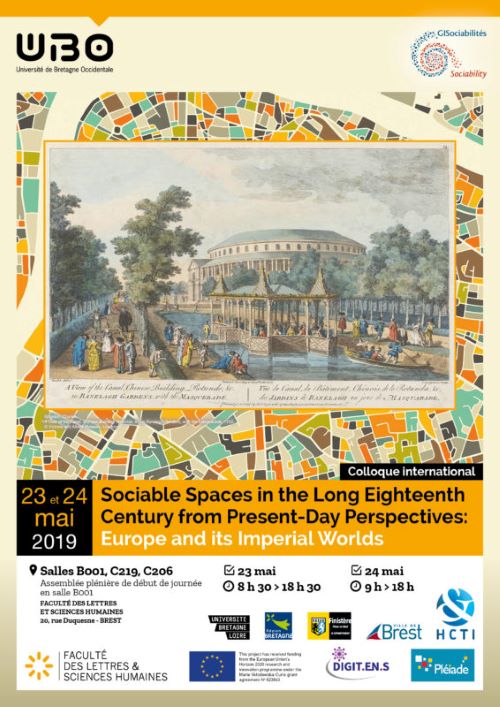
Organisers: Annick Cossic, Valérie Capdeville, Brian Cowan & Kimberley Page-Jones
The eighteenth century in Europe saw the emergence of new forms of sociability and the creation of new places devoted to sociable practices. By deeply transforming urban centres and by structuring people’s social relationships, those sociable practices became increasingly identified with their spatial features. They were naturally imitated in the colonies and adapted to their diverse local contexts. The conference interrogated the evolution of the long eighteenth-century’s sociable spaces and their persistence in time. Analysing the interaction of sociability and space and the modes of construction of sociable spaces from the modern period to the present day shed new light on the history of European and imperial societies.
The connection between space and society was theorised by the Chicago interactionist school in the 1920s (Park & Burgess, The City, 1925) and contemporary researchers have been equally keen to show how spatial theories apply to the production of urban social space (H. Lefebvre, La production de l’espace, 1974; E. Soja & Allen J. Scott. Postmodern Geographies: The Reassertion of Space in Critical Social Theory, 1989; Michel de Certeau. L’invention du quotidien. 1980) and how space can shape social identity (P. Grandjean, Construction identitaire et espace, 2009), favour inclusion or, conversely, exclusion. The long eighteenth century in particular played an important part in the formulation of social theories of space and society, particularly in the works of Habermas (L’Espace public: archéologie de la publicité comme dimension constitutive de la société bourgeoise, 1978), Richard Sennett (The Fall of Public Man, 2003), and Neil Postman (Building a Bridge to the Eighteenth Century, 2000). What is the relevance of eighteenth-century sociability for understanding the relationship between space and society in the 21st century? For instance, are the coffeehouses, clubs and social networks of today akin to those of the age of enlightenment?
The objective of this conference was to assess the role of the long eighteenth century’s sociable spaces in the shaping of European and postcolonial societies. This approach provided an original and long-range lens through which to understand their legacy, as sociability contributed to frame modern social interactions and to redefine space organization for the next centuries. Have those sociable spaces survived into the 21st century? How far have they been reconfigured in terms of social, cultural and political significance? To what extent have those spaces, devoted to human interaction, been transformed or redesigned by contemporary architects or urban planners for example? Papers were also to consider the relation between sociable spaces and class, gender, sexuality, race, etc., with social space being understood as “a system of differences” (P. Bourdieu, La distinction), a structuring and identifying factor for social organization.See programme and list of abstracts here.
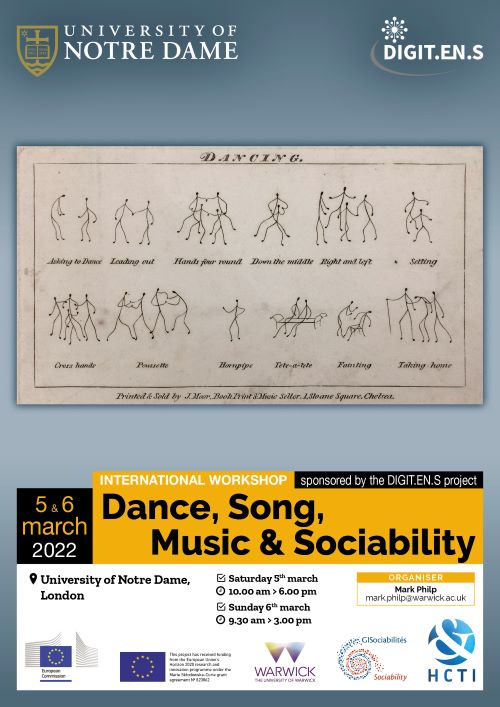
International conference: Dance, Song, Music and Sociability 1750 -1832.
Notre Dame, London, 5 & 6 March 2022
Organisers: Mark Philp (Warwick University) and Ian Newman (Notre Dame University)
Sociability is one of the single most significant ideas to emerge out of the eighteenth-century Enlightenment. The societies, clubs and institutions that underpinned intellectual exchange, made possible the scientific developments of the period, the development of "public opinion" through political meetings; and they helped form the entertainment industry through the commercialization of pleasure. Less widely understood, however, are the specific dynamics of sociability -- the ways that both institutions and private gatherings combined serious discussion with entertainment in the form of musical entertainment and dance. This conference will challenge the dominant understandings of Enlightenment sociability by placing music and dance at its core. Rather than thinking of music and dance as a peripheral ornament to the serious business of the Enlightenment, it will understand them as important engines in the development and dissemination of the ideas and practices that mobilised people’s bodies and emotions and shaped their social, emotional and intellectual worlds.
To see programme and guiding questions, click here.
International conference: Emotions and the City: Urban Sociability in Britain and France, c. 1650- c. 1850.
University of McGill, Montreal, 16 & 17 June 2022
Organisers: Brian Cowan (McGill University) and Pascal Bastien (Université du Québec à Montréal). Sponsored by the GRHS (Groupe de Recherche sur l'Histoire des Sociablités), the GIS Sociabilités / Sociability and the DIGITENS project.
Urban history and the history of emotions are now both well-established fields of inquiry, but the two fields have rarely engaged in dialogue with one another. This conference invites urban historians and historians of emotion to consider the connections between urban and emotional experiences in Europe during the long eighteenth century (c. 1650- c. 1850). We propose that these connections can best be explored through the lens of the history of sociability.
Eighteenth-century cities were both important spaces for the cultivation of new forms of sociability (e.g., clubs, coffeehouses, restaurants, libraries, academies), while at the same time older, more traditional forms of urban sociability (e.g., guilds, parish and civic governments, households, and the street) continued to play an important role in the lives of city dwellers. Cities were also key sites for new political organizations and experiences: London and Paris played key roles in the English and French revolutions, for example. The commercial world of eighteenth-century cities also created new forms of sociability, both in the form of lived experience as well as through constructing ‘imagined communities’ of readers and spectators. This new ‘public sphere’ has been the subject of sustained interest as cholars have tried to explore the ramifications of these new ways of living and imagining public life for people in the age of enlightenment. We encourage participants to consider the emotional and/or affective characters and consequences of the urban public sphere.
Further questions that conference presentations may wish to address include, but are not limited to, the following: Was there a particularly urban emotional experience? Did city life cultivate or privilege certain emotions over others? Were there significant variations in emotional experiences amongst the cities of early modern Europe? How did modes of urban sociability encourage or enhance certain emotional experiences? Did different cities, or different kinds of cities, cultivate different emotional experiences? Were there particular ‘emotional communities’ in the cities of early modern Europe?
International conference: 'Before Suffrage: Women, Politics and Society in Europe 1789-1850'.
Lyon, 15 & 16 September 2022.
Organisers: Mark Philp (Warwick University) and Anne Verjus (ENS Lyon)
The workshop examined a series of issues about the forms of activity in which women engaged that they themselves could see as having political dimensions or that sought to influence the direction taken by the communities and society of which they were a part. We see 1800-1850 as an especially important period in large part because of the extensive disruption in Europe following the French Revolution and the Napoleonic period of rule, and because of the extent to which that revolution triggered other popular rebellions and insurrections against the status quo across Europe. Instability often bred opportunity. For example, the period sees the emergence of new organizational forms, including, in some countries, women’s societies; in other countries, divided by war, women took an active part in forms of resistance and their organization. At the same time, what often started from very local beginnings, over time contributed to the emergence of a lexicon of popular politics and political ideas that were increasingly shared across European states – with liberalism, socialism, communism and conservatism emerging as organizing ideologies in the period, and with questions about the role and place of women in the political system being opened for examination and challenge.
Our interest is in exploring the range of parts that women in Europe played in the growing contestation and confrontation that developed in this period and that was increasingly coupled with political demands for reform or for recognition of various forms. At what points, in what ways, with what ends and aspirations did women act and with what awareness of breaking with customary expectations and traditional roles? How did their activity diverge from or further develop existing patterns of sociability and networks of association for women. What challenges and opportunities did war and revolution open to women; and for those states that avoided war, especially civil war, what place were women able to carve for themselves in the changing politics of their worlds? How did they reflect on their own activity, did they identify it as ‘political’ and in what ways (and what did they take that to mean), and how did others see it and respond to it. How should we see it?
The literature on women’s sociability has been dominated by relatively elite social groups and has focused heavily on the early modern period and the eighteenth century. This workshop moves questions of women’s sociability into the emergence of forms of popular protest and organization, to ask how far the tools and concepts of earlier studies might be deployed in a more turbulent period and across a very much wider social and geographical world. As a European political lexicon and set of movements comes into formation, it is important to reflect on the variety of roles that women were able to carve for themselves in this new contentious politics.
To see full programme, click here.
International conference: 'Levantine Sociabilities in Europe in Giacomo Casanova’s time: Spies, Impostors, Courtesans and Men of Culture'.
D'Annunzio University of Chieti, Pescara, Italy, 22 & 23 September 2022.
Organisers: Persida Lazaveric, Eleonora Sasso, Miriam Sette (D'Annunzio University of Chieti)
In the eighteenth century, intrigue, libertinage and criminality changed the social norms of politeness and education thereby creating nonconformist social behaviours. An explicit, but certainly not unique, manifestation of these new trends is represented by the city of Venice and its adventurer par excellence, Giacomo Casanova (1725-1798). Ecclesiastic, writer, soldier, spy, alchemist, gambler and diplomat, he was engaged in a network of social relationships which are documented in his Histoire de ma vie (History of My Life), one of the most authentic sources of the customs and norms of European social life during the eighteenth century. Like London, Paris and Vienna, Venice became a centre of social mobility, geographically located as the threshold of the Levant. At the crossroads of Eastern and Western empires, Venice promoted social interactions with Levantine representatives who wisely exploited these social connections to their own advantage. They behaved like shrewd men of business, even like fraudsters, whose “Levantine” attitudes may define a sociability of intrigue. A number of impostors, spies, merchants, sometimes also men of culture, thus contributed to redesigning the sociability of the eighteenth century. By transgressing social norms, they aimed to express their own political activism and socio-cultural views, and to display their eccentric manners.
Such dissident behaviours deeply affected British sociability whose gentleman ideal often remained difficult to reach. Liberty, individualism and eccentricity as embodied by Casanova became new social values subverting the function of some eighteenth-century taverns, coffeehouses and clubs. By mastering the arts of discourse, seduction, and disguise in Italian coffeehouses and elsewhere in Europe, we may wonder how Casanova and other Levantine agents influenced traditional spaces, forms and models of sociability. Wealthy young aristocrats, inspired by Italian fashion and style, were instrumental in making these subversive and deviant behaviours socially acceptable. Their conduct at times compromised official relationships and may have jeopardized social and political stability. The “Levantine” sociabilities eventually fostered encounters between the private and public spheres, the East and the West, and between different social classes.
This conference will encourage discussions and exchanges between international scholars on how national models of sociability and traditional Enlightenment values may have been affected and reconfigured by the Levantine practices of intrigue, libertinage and criminality. Through the multiple facets of Casanova (trickster, libertine, social climber, gambler, political agent …) and his European travels and networks, this conference will also address the circulation of knowledge and fashions between Europe and the East and the evolution of sociability thanks to various media: commerce, diplomacy, travel, letter-writing, translation, leisure and other sociable practices.
To see full programme, click here.
International conference: Sports and Sociability in the Long Eighteenth Century.
Sorbonne, Paris, 13 & 14 October 2022.
Organisers: Caroline Bertonèche (Université Grenoble Alpes) and Alexis Tadié (Sorbonne University)
This conference investigated the intricate relationships between sports and literature and the arts in the long eighteenth century. Sports are a particular good place to reflect on sociability, while the cultural approach enables an understanding of sports which goes beyond their history. We understand the place of sports in our societies if we look at their cultural representations and at the work they do.
Cultural representations of sports are ubiquitous in the long eighteenth century, and this conference provides an opportunity to explore them. For example, expressive forms intimately connected with the representation of sports are exemplary in books describing hunting, hawking, and fishing, which began to circulate from the second half of the seventeenth century. They contributed to the emergence of a culture of leisure and recreation, and induced a “recreation of a recreation,” to borrow the Compleat Angler’s words which celebrate both the pleasures of angling and the writing about angling. The eighteenth century saw the laying out of the rules of certain games, such as cricket, golf, or pugilism, as well as the birth of sports clubs, such as the Jockey Club or the Maylebone Cricket Club in England. But although sporting clubs are usually associated with the organisation of sports, they were initially social clubs. Simultaneously, paintings and texts, sometimes illustrated, started to flourish. For example, the portrayal of horses has long been identified with a form of artistic representation described as “Sporting Art” (Deuchar 1988). Although the category is a twentieth-century label, various expressions were used in the eighteenth century to describe such paintings or their authors: sporting pieces, horse-painters, etc. The word “mountaineering” was first coined by Coleridge. And in an entirely different field, the development of pugilism was inseparable from the debates over the modes of writing about it (Hazlitt 1822). Fighters like Daniel Mendoza, who authored The Art of Boxing in 1798, became icons, and were paraded on the stages of theatres in London. Keats among whose books was a volume called Fencing Familiarized was an excellent boxer and had more than an interest in pugilism while Byron’s sporting achievements belong to his mythology. Writing about fights, using the language of the “Fancy”, characterizes much of early nineteenth century writings, from Pierce Egan to William Hazlitt.
The cultures of sports define and project social and cultural issues, because they are places of contest, where certain crucial social issues are articulated. The issue of race, for instance, is central in the development of sports and was apparent as early as the eighteenth century when former slave Bill Richmond, who was brought to England from America at the age of fourteen to be a servant to the Duke of Northumberland, became a fighter and later a promoter of fights. Tom Molineaux, a former slave from Virginia, came to England to fight local champion Tom Crib. The conference therefore sought to reflect on a variety of social issues such as race, gender or violence through the lens of sports and of their cultural mediations. It investigated the modes of sociability induced by the practice of sports. It hopes to reflect on their literary and artistic expressions.
- Cycle de conférences
-
Cultural Transfers in European, Colonial and Global Contexts (1650-1850): the Circulation of Models of Sociability
From autumn 2018 to December 2019. See above for programme and podcasts of talks.
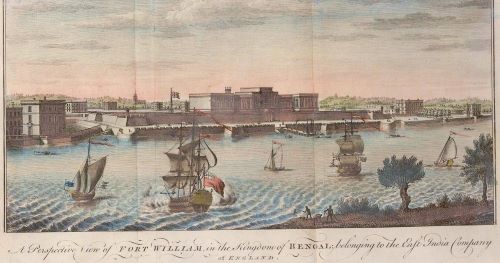
A perspective view of Fort William in the Kingdom of Bengal, belonging to the East India Company. Jan Van Ryne (1754). Sociabilité et libertinage au siècle des Lumières. En paralèlle de l'exposition 'L'Empire des sens, de Boucher à Greuze' au Musée Cognacq-Jay
(19 mai au 18 juillet 2021).
From spring 2021 to November 2021. See above for programme and podcasts of talks.
Représenter la sociabilité urbaine de Hogarth à Boilly. En parallèle de l'exposition 'Boilly. Chroniques parisiennes (1761-1845)
au Musée Cognacq-Jay (16 février au 26 juin 2022).
Spring and summer 2022. Podcasts soon online.
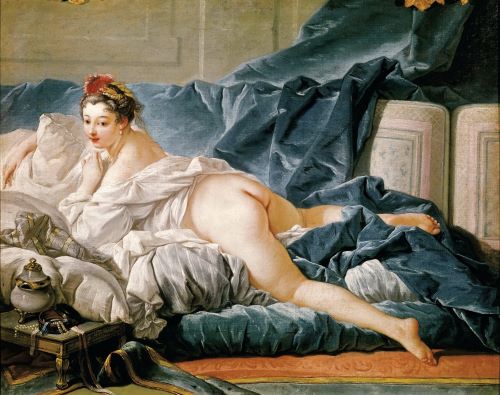
François Boucher, L'Odalisque Brune, 1745 - Séminaires et ateliers
-
'Sociability and the Discourses of Nature in the Long Eighteenth Century', DIGITENS workshop at the National Archives, London. 8 April 2022.
The papers will soon be published in a special issue of the journal Literature & History. To have access to DIGITENS report of workshop and deliverable, click here.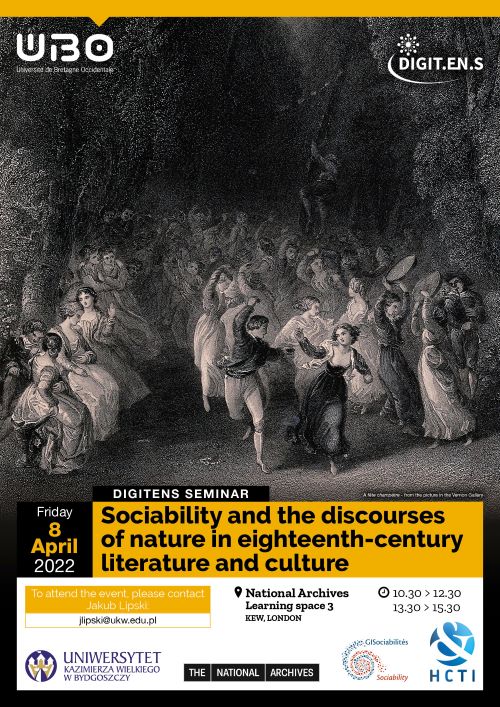
Organiser: Jakub Lipski, Tymon Adamczeswki and Karl Wood (Kazimierz Wielki University, Bydgoszczy)
The workshop was aimed at exmining how literary representations of sociability in the period were engaged with eighteenth-century ideas about nature, in general, and natural environments, in particular. To this end we explored literary representations and conceptualizations of sociability, and the ways in which they were interrelated with eighteenth-century discourses of the body, gender, human–animal relations, and human nature more broadly. The proposed papers offered focused studies of a number of eighteenth-century authors, from John Dryden to Samuel Taylor Coleridge, and they evaluated the extent to which sociable practices were represented as indispensable constituents of and factors determining selfhood, very much in line with Joseph Addison’s well-known idea of man as sociable animal. At the same time, we showed how reflections on the sociable self were also necessarily preoccupied with the external, ‘natural’ world: from the traditional city-countryside dialectic to the specifically eighteenth-century paradoxical reconciliation of the nature–artifice, nature–culture and nature–nurture binaries. Just as the popular spaces of sociability at the time, such as promenades, spas and gardens, purposely depended on the questionable arbitrariness of these binaries, in line with the oxymoronic Enlightenment ideal of nature civilized, so was sociability understood as both a pattern of culture and a natural predisposition. Taught as part of the socio-cultural programming at the time, it was also felt to be part of man’s natural constitution: an impulse or a passion, for example.
DIGITENS Network Event: Of Eighteenth-Century Merchants and the Enslaved: Records at The National Archives. 25 May. Online event.
Organiser: Philippa Hellawell (Early Modern Records Specialist (18th century)) - philippa.hellawell@nationalarchives.gov.uk
The workshop organized by Philippa Hellawell (Early Modern Records Specialist (18th century)) and Oliver Finnegan (Prize Papers Record Specialist) from the National Archives aimed to present the content of two collections related to eighteenth-century mercantile history and the history of slavery, and the potential they hold for researchers working on social connections, reputations or commercial networks. Merchant activity was bound up with various sociable practices with their credit and trustworthiness based on commercial connections forged through networks, reputations, and relationships. Records can build up knowledge of mercantile networks and merchant’s social activity, but, in the context of slavery, they also conceal the experience of those they enslaved and imprisoned.
The presentation of these collections was followed by two research presentations given by DIGITENS members who have used eighteenth-century records at the National Archives for their research work on networks of merchants and communities of prisoners. See below for link to their powerpoint presentation.
Philippa Hellawell presented the records of the Royal African Company (MSS T70 collection) which span the period 1672-1750. The T70 collection is comprised of 1696 volumes across 44 sub-series including documents such as letter books, minute books, reports and orders, advice books, petitions, reports of the parliamentary, invoice books, debts … She focused specifically on letterbooks (74 volumes from 1678-1818) showing us extracts of letters to and from merchants located in Exeter, Hamburg and Rotterdam written in 1720-1723 (T70/24). These letters give us a glimpse of connexions between merchants within Britain but also at a European level, and their commercial and epistolary practises.
The ‘Lists of the Living and Dead’ (T50/1435-1456) provide a list of the employees of the company, their occupation, whether they were discharged or not and when they had died. This type of record enables researchers to go beyond the position of merchants and examine other occupations and how people related to each other within the company.
The Ship’s Books (T70 1210-1228) gather various types of documents related to a voyage such as accounts, journals or ship’s passes. The journal of the ship James (T70 1225) for instance is a very troubling document: it details slave mortality in the Middle Passage aboard the ship James sailing in 1676 from the Gold Coast to Barbados. If it is challenging to try and extract the voices of the enslaved from accounts, ledgers and other type of commercial documents, the ship’s journals nonetheless give us a glimpse of the horror of the Middle Passage for the enslaved. Out of 413 slaves, 58 died and we are given in this record the account of 51 deaths due to extreme thinness, illness, malnutrition, dropsy, conventions, childbirth and suicide.
Spotlight on TNA Collections
‘Approaching the Records of the Royal African Company’, Philippa Hellawell, Eighteenth Century Records Specialist, The National Archives: link to presentation.
‘The Prize Papers’, Oliver Finnegan, Prize Paper Records Specialist, The National Archives - ‘Two Ships of Nantes: Sources from the Atlantic slave trade in the Prize Papers’.
Using TNA’s Records
‘Portchester’s Black French prisoners of war 1796-1801: Using Kew’s archives to recover their story’, Abigail Coppins, University of Warwick – link to presentation
‘The Prize papers and neutral shipping during the Revolutionary Wars (1793-1795)’, Pierrick Pourchasse, Université de Bretagne Occidentale – link to presentation
- Ateliers
-
New accordion content
Video clips and blog articles
- Clips vidéo
-
Created by the audiovisual service of the UBO (the DUN), these video clips contrast eighteenth-century objects and practices of sociability with today’s practices. Reflecting on eighteenth-century sociable practices should also make us think of how and why we use these forms of sociability today and what values we attached to these objects and practices.
Prof. Annick Cossic on the town of Bath, spa culture and politeness:
https://ubotube.univ-brest.fr/videostream/video/annick_cossic/
Dr Kimberley Page-Jones on the politics of prize-fighting in Britain:
https://ubotube.univ-brest.fr/videostream/video/kimberley_pagejones/
- Billets GALLICA
-
Gallica is a digital library created by the Bibliothèque nationale de France (BnF) in 1997. It gathers millions of digitized materials from the BnF and its partners' collections. The BnF makes use of these vast resources to share knowledge through the Gallica blog. Below are the blog articles stemming from the DIGITENS project research activities (in French).
- Isabelle le Pape (Bibliothèque nationale de France) : Amitiés épistolaires dans les arts au XVIIIe siècle, 11 juin 2020.
À la période des Lumières, la lettre devient le lieu où s’invente une nouvelle liberté de penser. Le siècle des correspondances voit ainsi se développer des amitiés épistolaires qui font le bonheur des écrivains, des philosophes et des hommes et femmes de lettres, parmi lesquels Voltaire, Rousseau, Mme du Deffand, Julie de Lespinasse ou encore Mme d’Épinay. L’écriture épistolaire se fait le terrain d’exercice favori d’une pensée en progrès.
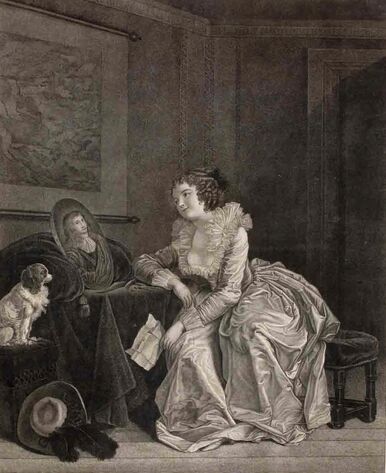
Alexandre Fragonard, La Nouvelle du retour, 1820. - Kimberley Page-Jones & Adnana Sava (Université de Bretagne Occidentale) : La sociabilité, un penchant naturel ?, 5 octobre 2020.
Qu’est-ce qui pousse l’individu à rechercher la compagnie de ses semblables ? Des gilets jaunes à la pandémie, l’actualité sociale, politique et sanitaire de ces derniers mois nous fait réfléchir plus que jamais à notre besoin de sociabilité, cette aptitude de l’individu à fréquenter agréablement ses semblables, aptitude qui se décline néanmoins différemment d’une nation à l’autre.
- Isabelle Breuil (Bibliothèque nationale de France) : "Murs de papier", La collection de papiers peints du 18ème siècle dans Gallica : historique (1), 14 mars 2019.
Le 15 novembre dernier, l’ouvrage de Christine Velut, Murs de papier, (BnF éditions) a été distingué par le prix des librairies de livre d’art et du beau livre 2018. Sous la forme d’un répertoire de motifs, ce livre nous invite à explorer la collection d’échantillons de papiers peints entrés à la Bibliothèque Nationale, à la faveur de la législation révolutionnaire du 19 juillet 1793 : celle-ci incitait les manufacturiers à y déposer leurs créations, pour se protéger de la contrefaçon.
- Isabelle Breuil (Bibliothèque nationale de France) : La collection de papiers peints du 18ème siècle dans Gallica : quelques motifs (2), 15 mars 2019.
A la fin des années 1790, une mode va en quelque sorte faire pénétrer l’extérieur dans les intérieurs ; la végétation devient foisonnante et la nature reprend ses droits par sa luxuriance : de véritables jardins se déploient dans les maisons, donnant jusqu’à l’illusion de treillages par l’utilisation de trompes-l’œil.
Les représentations de fleurs sur les papiers peints se font aussi l’écho de la mode textile : aux fleurs, en toile de fond en quelque sorte, s’ajoute la trame textile qui suggère une texture en transparence, basin, linon batiste ou tulle.- Isabelle Breuil (Bibliothèque nationale de France) : La mode anglomane au 18ème siècle, 11 mars 2020.
Dans le cadre du projet européen Digitens auquel collabore la BnF, portant sur les sociabilités britanniques au 18ème siècle, des marque-pages ont été édités à l'effigie des silhouettes de mode anglomane, échappées des pages du premier journal de mode français, le Magasin des modes nouvelles françaises et anglaises. Nous vous proposons de retracer ici la fureur anglomane qui s'est emparée du vestiaire parisien dans la deuxième moitié du 18ème siècle, et d'exposer ici quelques-unes de ses pièces maîtresses.
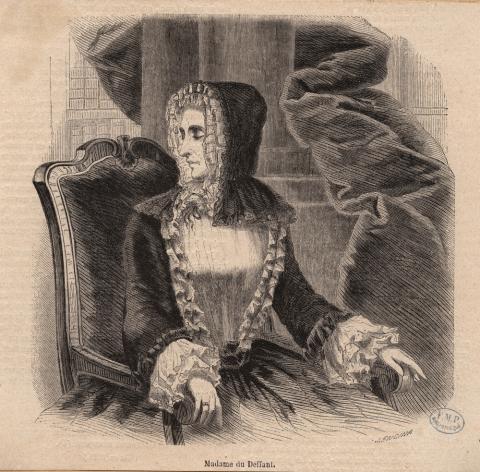
- Isabelle Le Pape et Monique Calinon (Bibliothèque nationale de France) : Horace Walpole et Mme du Deffand : une étonnante "amitié", 12 mars 2020.
Quand une grande Dame tenant l’un des plus célèbres Salons s’éprend au soir de sa vie d’une Gloire venue d’Angleterre. Rencontre au sommet de deux grands esprits qui tout en ne s’aimant pas vraiment se sont beaucoup aimés.
-
Publications
- La collection Transversales
-
La collection Transversales, dirigée par Annick Cossic aux Editions Le Manuscrit, rassemble les réflexions menées depuis 2009 sur la sociabilité en France et en Grande-Bretagne au Siècle des Lumières et comporte 6 tomes.
Le XVIIIe siècle est éminemment moderne, car le nouveau modèle de société qui émerge au temps des Lumières diffuse sa puissance disséminatrice jusqu’à nos jours. Foncièrement pluridisciplinaire, la collection Transversales réunit de nombreux universitaires spécialistes de la France et de la Grande-Bretagne du XVIIIe siècle pour étudier les formes, les fonctions et les modes opératoires de la sociabilité dans ces deux nations.
Cette « archéologie du savoir » initiée en 2009 par la maison des Sciences Humaines de Bretagne (Université de Brest) permet, à travers une lecture croisée de la sociabilité des Lumières, de proposer une approche novatrice de la naissance puis de l’influence de ce nouveau modèle, remettant ainsi en cause plusieurs présupposés, notamment celui de la supériorité du modèle français de sociabilité.- Tome 1 : Les vecteurs d’une nouvelle sociabilité – entre ludique et politique (dir. Annick Cossic & Allan Ingram, 2012)
- Tome 2 : Les enjeux thérapeutiques et esthétiques de la sociabilité au XVIIIe siècle (dir. Annick Cossic & Hélène Dachez, avril 2013)
- Tome 3: Les espaces de sociabilité (dir. Valérie Capdeville & Eric Francalanza, mai 2014)
- Tome 4 : Utopie, individu et société : la sociabilité en question (dir. Allan Ingram & Norbert Col, juin 2015)
- Tome 5 : Sociabilités et esthétique de la marge (dir. Annick Cossic & Alain Kerhervé, mars 2016)
- Tome 6 : L'insociable sociabilité : résistances et résilience (dir. Katherine Aske et Kimberley Page-Jones, décembre 2017).
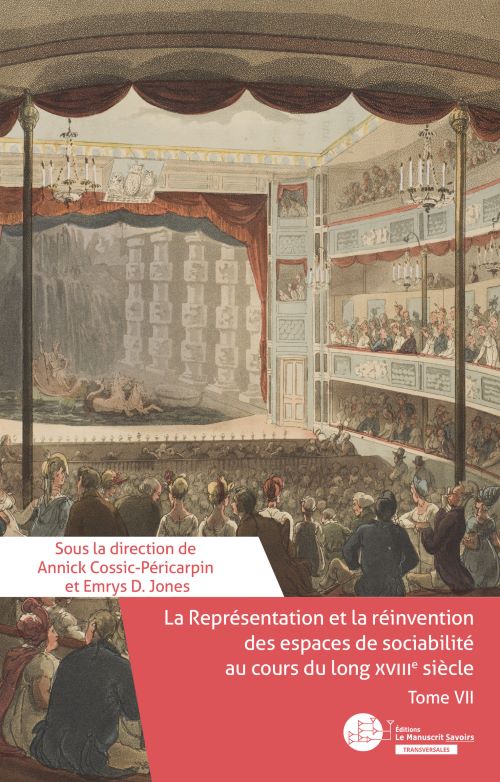
- Tome 7 : La Représentation et la réinvention des espaces de sociabilité au cours du long XVIIIe siècle (dir. Annick Cossic et Emrys D. Jones, mars 2021).
- Tome 8 : Les réseaux de sociabilité dans la culture des Lumières. Circulations, échanges et transferts (dir. Vanessa Alayrac-Fielding & Sophie Mesplède). A paraitre en décembre 2022.
- Les ouvrages collectifs
-
Valérie Capdeville & Alain Kerhervé (eds.), British Sociability in the Long Eighteenth Century: Challenging the Anglo-French Connection (Boydell & Brewer, UK, 2019).
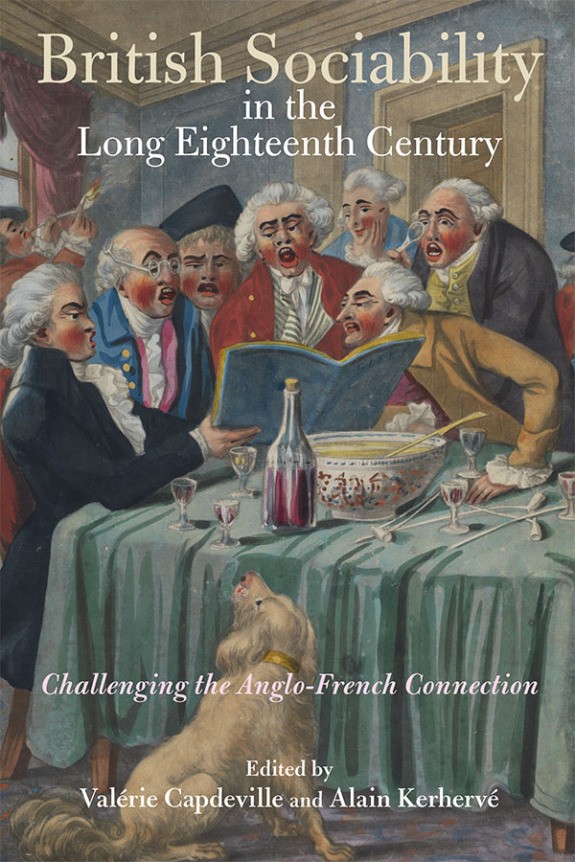
The study of sociability in the long eighteenth century has long been dominated by the example of France. In this innovative collection, we see how a distinctively British model of sociability developed in the period from the Restoration of Charles II to the early nineteenth century through a complex process of appropriation, emulation and resistance to what was happening in France and other parts of Europe.
The contributors use a wide range of sources - from city plans to letter-writing manuals, from the writings of Edmund Burke to poems and essays about the social practices of the tea table, and a variety of methodological approaches to explore philosophical, political and social aspects of the emergence of British sociability in this period. They create a rounded picture of sociability as it happened in public, private and domestic settings - in Masonic lodges and radical clubs, in painting academies and private houses - and compare specific examples and settings with equivalents in France, bringing out for instance the distinctively homo-social and predominantly masculine form of British sociability, the role of sociability within a wider national identity still finding its way after the upheaval of civil war and revolution in the seventeenth century, and the almost unique capacity of the British model of sociability to benefit from its own apparent tensions and contradictions.VALÉRIE CAPDEVILLE is Senior Lecturer in British Civilisation at the University of Paris 13.
ALAIN KERHERVÉ is Professor of British Studies at the Faculté des Lettres et Sciences Humaines Victor Segalen, University of West Brittany (UBO Brest).
CONTRIBUTORS: Pierre-Yves Beaurepaire, Valérie Capdeville, Michèle Cohen, Norbert Col, Annick Cossic, Brian Cowan, Rémy Duthille, Markman Ellis, Allan Ingram, Emrys Jones, Alain Kerhervé, Elisabeth Martichou, Marie-Madeleine Martinet, Ian Newman, Jane Rendall
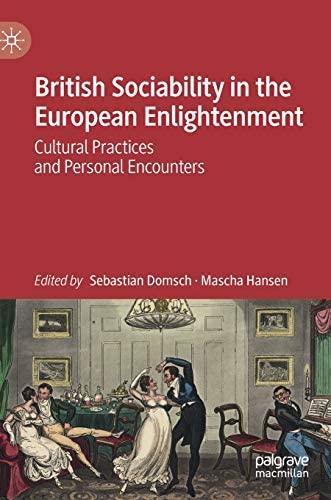
Sebastian Domsch & Mascha Hansen (eds.), British Sociability in the European Enlightenment: Cultural Practices and Personal Encounters (Palgrave Macmillan, 2021).
This volume covers a broad range of everyday private and public, touristic, commercial and fictional encounters between Britons and continental Europeans, in a variety of situations and places: moments that led to a meaningful exchange of opinions, practices, or concepts such as friendship or politeness. It argues that, taken together, travel accounts, commercial advice, letters, novels and philosophical works of the long eighteenth century, reveal the growing impact of British sociability on the sociable practices on the continent, and correspondingly, the convivial turn of the Enlightenment. In particular, the essays collected here discuss the ways and means – in conversations, through travel guides or literary works – by which readers and writers grappled with their cultural differences in the field of sociability. The first part deals with travellers, the second section with the spreading of various cultural practices, and the third with fictional encounters in philosophical dialogues and novels.
SEBASTIAN DOMSCH, Chair of Anglophone Literatures at the University of Greifswald, Germany, is the author of The Emergence of Literary Criticism in 18th-Century Britain (2014) and co-editor of British and European Romanticisms (2007) and Romantic Ambiguities: Abodes of the Modern (2017).
MASCHA HANSEN, Lecturer in British Literature at the University of Greifswald, Germany, focuses on women in the long eighteenth century, and has published on Frances Burney, the Bluestockings, Hester Thrale and Queen Charlotte. Her particular interests range from women’s life writings to their involvement in sociability, science and education.
- Numéros dans revue ou journal
-
Sociable Spaces in Eighteenth-Century Britain: A Material and Visual Experience, Valérie Capdeville et Pierre Labrune (eds.), Études anglaises, 74.3 (2021)
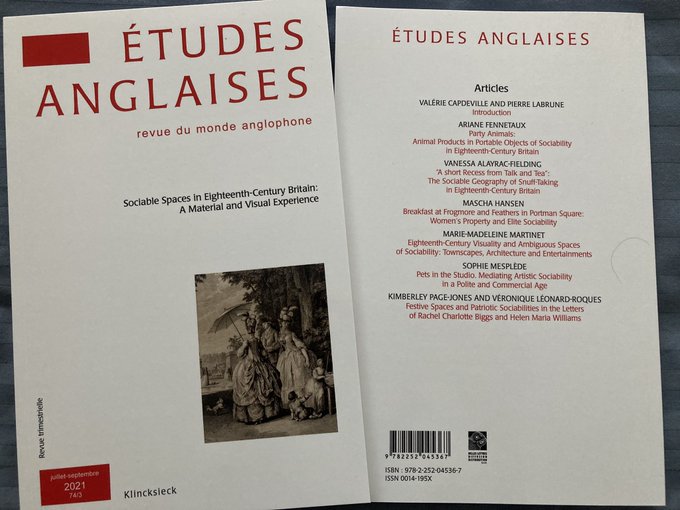
Building on the collaborative work of the GIS Sociabilités within the framework of the EU-funded H2020 DIGITENS research project,3 this selection of articles not only investigates the multi-layered notion of social space, but also considers how the materiality and visuality of sociability in eighteenth-century Britain reconfigure space and spatial experience. It explores how sociable interactions and practices are fashioned and staged through the medium of material objects within specific spaces and, in turn, how these sociable spaces may shape social identities and connections. The six contributions assembled in this special issue adopt different approaches and methodologies and provide new readings of the spatial and visual properties and perceptions of sociable interactions, inviting us to look for the traces of eighteenth-century sociability in contemporary practices and spaces.
Valérie CAPDEVILLE and Pierre LABRUNE : Introduction
Ariane FENNETAUX : Party Animals: Animal Products in Portable Objects of Sociability in Eighteenth-Century Britain
Vanessa ALAYRAC-FIELDING : “A short Recess from Talk and Tea”: The Sociable Geography of Snuff-Taking in Eighteenth-Century Britain
Mascha HANSEN : Breakfast at Frogmore and Feathers in Portman Square: Women’s Property and Elite Sociability
Marie-Madeleine MARTINET : Eighteenth-Century Visuality and Ambiguous Spaces of Sociability: Townscapes, Architecture and Entertainments
Sophie MESPLÈDE : Pets in the Studio. Mediating Artistic Sociability in a Polite and Commercial Age
Kimberley PAGE-JONES and Véronique LÉONARD-ROQUES : Festive Spaces and Patriotic Sociabilities in the Letters of Rachel Charlotte Biggs and Helen Maria Williams.
- Publications en accès ouvert
-
Liste des articles, ouvrages et chapitres d'ouvrage, publiés dans le cadre du projet H2020 RISE DIGITENS et disponibles en accès ouvert. Pour télécharger la liste, cliquer ici.